Meaning of This Ritual
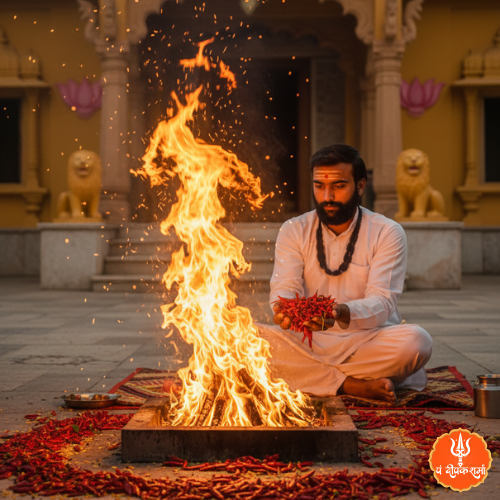
The baglamukhi shatrunashakl havan is a sacred fire ritual dedicated to Devi Baglamukhi, one of the ten Mahavidyas. This havan is performed with the intention of removing enemies and obstacles that hinder one’s progress in life. The term ‘Shatrunashakl’ translates to the annihilation of foes, making this ritual particularly significant for those facing adversities from rivals, be it in personal or professional spheres. The essence of this havan lies in invoking the divine energies of Baglamukhi Mata, who is revered for her power to control and subdue adversaries.
In this ritual, specific offerings are made into the sacred fire, accompanied by powerful mantras that resonate with the energies of protection and victory. The havan serves as a medium to channel divine blessings, ensuring that the devotee is shielded from negative influences and empowered to overcome challenges. The profound significance of this ritual is rooted in the belief that by surrendering to the divine, one can attain strength and clarity to navigate through life’s tumultuous waters.
Moreover, the havan is not merely a ritual; it is a spiritual journey that fosters a deep connection with the divine. It encourages devotees to reflect on their intentions and seek guidance from Baglamukhi Mata, who is known to bestow wisdom and strength upon her followers. Thus, the Baglamukhi Shatrunashakl Havan is a holistic approach to overcoming obstacles, ensuring that one is not only protected but also guided towards a path of righteousness and success.
How This Ritual Helps
The Baglamukhi Shatrunashakl Havan is a powerful spiritual practice that aids individuals in various aspects of life. Primarily, it is known for its effectiveness in neutralizing the negative influences of enemies. By performing this havan, devotees invoke the blessings of Devi Baglamukhi, who is believed to grant protection and victory over adversaries. This ritual is especially beneficial for those involved in legal disputes, business rivalries, or personal conflicts, as it helps in turning the tides in their favor.
Additionally, the havan serves as a means of spiritual cleansing. It purifies the environment and the individual, creating a sacred space that fosters positive energies. As the offerings are made to the fire, the negative energies associated with enmity and conflict are believed to be consumed, allowing for a fresh start. This purification process not only aids in overcoming external challenges but also helps in addressing internal fears and doubts, empowering the devotee to face adversities with confidence.
Furthermore, the Baglamukhi Shatrunashakl Havan instills a sense of peace and tranquility within the devotee. The meditative aspect of the ritual, combined with the chanting of mantras, creates a serene atmosphere that calms the mind and spirit. This inner peace is crucial for making sound decisions and approaching conflicts with a clear mind. Thus, the havan not only protects against external threats but also nurtures the inner strength required to confront life’s challenges.
Mythological Background
The mythology surrounding Devi Baglamukhi is rich and profound, deeply rooted in Hindu traditions. She is one of the ten Mahavidyas, a group of powerful goddesses who embody various aspects of the divine feminine. Baglamukhi is revered as the goddess of speech, knowledge, and power, known for her ability to control and subdue enemies. According to ancient texts, she emerged from the divine energy of Lord Shiva and Goddess Shakti, embodying the strength to protect her devotees from harm.
One of the most significant legends associated with Baglamukhi is the tale of her intervention during a fierce battle between the gods and demons. The demons, empowered by their arrogance, threatened the balance of the universe. In response, Devi Baglamukhi manifested to restore order. With her divine powers, she subdued the demons, demonstrating her ability to control even the most formidable foes. This act of protection solidified her status as a guardian deity, revered by those seeking victory over adversaries.
Moreover, Baglamukhi’s connection to the spoken word is pivotal in understanding her role in the lives of her devotees. She is believed to grant the power of eloquence and persuasion, making her a favored deity among those involved in legal matters or public speaking. The Baglamukhi Shatrunashakl Havan, therefore, not only serves to remove enemies but also empowers devotees with the strength of speech and intellect, enabling them to articulate their thoughts and defend their positions effectively.
Who Should Perform This
The Baglamukhi Shatrunashakl Havan is particularly beneficial for individuals facing challenges posed by rivals or enemies. Those involved in legal disputes, business competitions, or personal conflicts may find solace and strength through this ritual. It is also recommended for individuals who feel overwhelmed by negative energies or are in situations where they feel threatened or oppressed. The havan acts as a protective shield, allowing devotees to reclaim their power and navigate through adversities with confidence.
Moreover, this ritual is suitable for anyone seeking to enhance their spiritual journey. It is not limited to those facing external challenges; even individuals looking to strengthen their inner resolve and clarity can benefit from the Baglamukhi Shatrunashakl Havan. The act of surrendering to the divine and seeking guidance from Baglamukhi Mata fosters a deeper connection with the spiritual realm, enriching one’s life with wisdom and strength.
Additionally, the havan can be performed by family members on behalf of loved ones who may be facing difficulties. In such cases, the collective energy of family prayers amplifies the effectiveness of the ritual, creating a supportive environment for healing and protection. Thus, the Baglamukhi Shatrunashakl Havan is a versatile ritual that caters to a wide range of devotees, each seeking the blessings of Devi Baglamukhi for different reasons.
Step-by-Step Vidhi (Very Detailed)
The performance of the Baglamukhi Shatrunashakl Havan follows a meticulous Vedic process, ensuring that every aspect aligns with traditional practices. The ritual begins with the selection of an auspicious date and time, preferably during a full moon or on a Friday, which is considered favorable for worshipping Baglamukhi. It is essential to prepare the havan kund, a sacred fire pit, with pure materials like clay or metal, ensuring it is cleansed and consecrated before use.
Once the havan kund is ready, the devotee should take a bath and wear clean, preferably yellow or white clothes, symbolizing purity and devotion. The next step involves invoking the presence of Devi Baglamukhi through a series of prayers and offerings. The devotee should light the sacred fire in the havan kund, using pure ghee and wood, while chanting the appropriate mantras to invite the goddess’s blessings.
As the fire burns, specific offerings are made into the flames, including grains, flowers, and other sacred items. Each offering is accompanied by the chanting of mantras, such as the powerful mantra for enemy removal: ॐ ह्लीं बगलामुखि सर्व शत्रुस्तम्भनाय स्वाहा (Om Hleem Baglamukhi Sarva Shatrusambhanaya Swaha). This mantra invokes the protective energies of Baglamukhi, ensuring that all negative influences are neutralized. The devotee should maintain focus and devotion throughout the ritual, visualizing the goddess enveloping them in her protective aura.
Mantra for This Ritual
The primary mantra associated with the Baglamukhi Shatrunashakl Havan is ॐ ह्लीं बगलामुखि सर्व शत्रुस्तम्भनाय स्वाहा. This mantra, when chanted with devotion, invokes the protective energies of Devi Baglamukhi, ensuring the removal of enemies and obstacles. The mantra can be transliterated as Om Hleem Baglamukhi Sarva Shatrusambhanaya Swaha. Each syllable carries profound significance, resonating with the energies of protection and victory.
The syllable ‘ॐ’ (Om) represents the primordial sound of the universe, symbolizing the essence of the divine. ‘ह्लीं’ (Hleem) is a powerful seed mantra associated with Baglamukhi, embodying her protective qualities. The phrase ‘सर्व शत्रुस्तम्भनाय’ (Sarva Shatrusambhanaya) translates to ‘for the subjugation of all enemies,’ emphasizing the mantra’s purpose. Finally, ‘स्वाहा’ (Swaha) is a sacred term used during offerings, signifying the surrender of the offerings to the divine.
Chanting this mantra during the havan not only enhances its effectiveness but also establishes a direct connection with Devi Baglamukhi. It is recommended to chant the mantra a specific number of times, ideally 108, to amplify its power. Devotees are encouraged to maintain a focused mind and heart, visualizing their intentions as they chant, thus inviting the goddess’s blessings into their lives.
Do’s & Don’ts
When performing the Baglamukhi Shatrunashakl Havan, certain guidelines should be followed to ensure the ritual’s effectiveness. Among the do’s, it is essential to maintain a pure and focused mindset throughout the ritual. Devotees should engage in self-reflection and prayer before commencing the havan, setting clear intentions for what they wish to achieve. Additionally, using pure materials for the havan, such as organic ghee and natural wood, is crucial, as it aligns with the principles of Vedic rituals.
Another important aspect is to chant the mantras with devotion and concentration. Each mantra carries divine energy, and reciting them with sincerity enhances the connection with the goddess. It is also advisable to perform the havan in a clean and sacred space, free from distractions, to create an environment conducive to spiritual growth.
On the other hand, there are certain don’ts to be mindful of. Avoid performing the havan during inauspicious times, such as eclipses or on days dedicated to other deities. It is also important not to rush through the ritual; each step should be performed with reverence and patience. Lastly, refrain from using impure or synthetic materials in the offerings, as they can dilute the sanctity of the ritual. By adhering to these do’s and don’ts, devotees can ensure that their Baglamukhi Shatrunashakl Havan is performed with the utmost respect and devotion.
When to Perform
The timing of the Baglamukhi Shatrunashakl Havan plays a significant role in its effectiveness. It is most auspicious to perform this ritual during specific lunar phases, particularly on full moon days or during the waxing phase of the moon. Fridays are also considered highly favorable for worshipping Baglamukhi, as this day is dedicated to the goddess and is believed to enhance the potency of the rituals performed.
Additionally, it is advisable to choose a time when the devotee is free from distractions and can dedicate their full attention to the ritual. Early morning hours, known as Brahma Muhurta, are considered ideal for spiritual practices, as this time is believed to be filled with divine energies. Performing the havan during this period can amplify its effects, allowing the devotee to connect more deeply with Devi Baglamukhi.
Moreover, if the devotee is facing specific challenges, such as legal issues or conflicts with enemies, it is recommended to perform the havan as soon as possible. The sooner the ritual is conducted, the quicker the energies of protection and resolution can manifest in the devotee’s life. Thus, being mindful of the timing can significantly enhance the effectiveness of the Baglamukhi Shatrunashakl Havan.
How Pandit Deepak Sharma can help
Pandit Deepak Sharma, an experienced Vedic practitioner, offers his expertise in performing the Baglamukhi Shatrunashakl Havan with authenticity and devotion. With over 25 years of experience, he ensures that every ritual is conducted according to traditional Vedic practices, allowing devotees to receive the maximum benefits from their spiritual endeavors. His deep understanding of the scriptures and the nuances of the rituals enables him to guide devotees through the process with clarity and compassion.
By seeking the guidance of Pandit Deepak Sharma, devotees can rest assured that their havan will be performed with the utmost respect for the divine. He takes care to create a sacred environment, ensuring that all materials used are pure and aligned with Vedic principles. Furthermore, his personalized approach means that he takes the time to understand the unique challenges faced by each devotee, tailoring the rituals to address their specific needs and intentions.
Additionally, Pandit Deepak Sharma provides spiritual guidance beyond the havan itself. He offers insights into the significance of the rituals, helping devotees understand the deeper meanings behind their actions. This holistic approach fosters a stronger connection with Devi Baglamukhi, empowering devotees to navigate their lives with confidence and clarity. Thus, engaging with Pandit Deepak Sharma for the Baglamukhi Shatrunashakl Havan is a step towards spiritual empowerment and protection.
Nalkheda Temple Connection
The Nalkheda Temple, dedicated to Devi Baglamukhi, holds immense significance for devotees seeking her blessings. Located in the Agar Malwa district of Madhya Pradesh, this temple is a revered pilgrimage site for those wishing to connect with the divine energies of Baglamukhi. The temple’s serene ambiance and spiritual vibrations create an ideal setting for performing the Baglamukhi Shatrunashakl Havan, allowing devotees to immerse themselves in the sacred atmosphere.
Visiting the Nalkheda Temple not only provides an opportunity for darshan but also enhances the effectiveness of the havan. The temple is believed to be a powerful energy center, where the vibrations of devotion and faith resonate strongly. Performing the havan in the vicinity of the temple amplifies the energies, ensuring that the offerings reach Devi Baglamukhi with sincerity and devotion.
Moreover, the temple is frequented by numerous devotees seeking relief from various challenges, creating a community of faith and support. Engaging in the Baglamukhi Shatrunashakl Havan at the Nalkheda Temple fosters a sense of belonging and shared purpose among devotees, further enhancing the spiritual experience. Thus, the connection to the Nalkheda Temple is integral to the practice of the Baglamukhi Shatrunashakl Havan, enriching the ritual with divine blessings.
FAQ
What is the significance of the Baglamukhi Shatrunashakl Havan?
The Baglamukhi Shatrunashakl Havan is significant for its power to remove enemies and obstacles in one’s life. It is performed to invoke the blessings of Devi Baglamukhi, who is known for her ability to control adversaries and provide protection. This ritual is particularly beneficial for individuals facing legal disputes, business rivalries, or personal conflicts, as it helps in turning the tides in their favor.
Additionally, the havan serves as a means of spiritual cleansing, purifying the devotee and their environment. By surrendering to the divine and seeking guidance from Baglamukhi Mata, devotees can overcome negative influences and gain clarity in their lives. Thus, the havan is a holistic approach to overcoming challenges, ensuring that one is not only protected but also guided towards a path of righteousness and success.
Can anyone perform the Baglamukhi Shatrunashakl Havan?
Yes, the Baglamukhi Shatrunashakl Havan can be performed by anyone seeking the blessings of Devi Baglamukhi. It is particularly beneficial for individuals facing challenges posed by rivals or enemies. However, it is also suitable for those looking to enhance their spiritual journey and strengthen their inner resolve. The ritual can be performed by family members on behalf of loved ones, amplifying the collective energy of family prayers.
It is important for the devotee to approach the ritual with a pure heart and clear intentions. Engaging in self-reflection and prayer before the havan can enhance its effectiveness, allowing the devotee to connect more deeply with the divine. Thus, the havan is accessible to all who seek the blessings of Baglamukhi Mata.
What materials are needed for the havan?
The materials required for the Baglamukhi Shatrunashakl Havan include pure ghee, natural wood, grains, flowers, and other sacred items for offerings. It is essential to use organic and pure materials to align with the principles of Vedic rituals. The havan kund, or fire pit, should be prepared with care, ensuring it is cleansed and consecrated before use.
Additionally, devotees may also include items that hold personal significance, such as photographs or symbols representing their intentions. The offerings made during the havan should be accompanied by the chanting of mantras, enhancing the connection with Devi Baglamukhi and amplifying the effectiveness of the ritual.
How long does the havan take to perform?
The duration of the Baglamukhi Shatrunashakl Havan can vary depending on the devotee’s intentions and the specific rituals performed. Typically, the havan may take anywhere from one to two hours, allowing ample time for the preparation, invocation, and offerings. It is important to approach the ritual with patience and reverence, ensuring that each step is performed with devotion.
Devotees are encouraged to maintain focus and sincerity throughout the ritual, as this enhances the connection with the divine. The time spent in the havan is an investment in spiritual growth and protection, making it a meaningful experience for all involved.
Is it necessary to have a priest perform the havan?
While it is not strictly necessary to have a priest perform the Baglamukhi Shatrunashakl Havan, engaging an experienced Vedic practitioner can significantly enhance the effectiveness of the ritual. A knowledgeable priest, such as Pandit Deepak Sharma, ensures that the havan is conducted according to traditional Vedic practices, allowing devotees to receive the maximum benefits from their spiritual endeavors.
Moreover, a priest can provide guidance and support throughout the ritual, helping devotees understand the significance of each step and the mantras being chanted. This personalized approach fosters a deeper connection with Devi Baglamukhi, empowering devotees to navigate their lives with confidence and clarity. Thus, while individuals can perform the havan independently, seeking the assistance of a priest is highly recommended for a more enriching experience.